Thursday, April 11, 2013

Movements of Nature in Chinese Medicine - Spring Time Part I

"I sit with my back against an old oak tree,
The wind blows, grass lifts around me,
The tree remains steady,
The wind pushes me forward,
My eyes tear with the rising impulse,

Spring bursts forth,
It is full of life,
Vision clear,
See the plan,
 
What do you see,
What do you judge,
What is the plan,
Shout to the world,"


In Chinese thought there are many ways of describing the world around us and our experience of it. One of them is the model of the Five Elements, or Five Phases. I prefer the term Five Phases because it denotes movements of energy over periods of time as opposed to static building blocks of reality. The Chinese phases are Wood, Fire, Earth, Metal, and Water. In a previous post I described some of the qualities of Fire as it relates to the Heart organ-meridian system. In this post we will explore the season of Spring which is associated with Wood.

Wood Correspondences (in Chinese Five Phase Theory)
Emotion
Anger
Yin Organ
Liver
Yang Organ
Gallbladder
Sense Organ
Eyes
Body Part
Tendons
Body Fluid
Tears
Sense
Sight
Taste
Sour
Life
Birth
Season
Spring
Color
Blue-green
Virtue
Judgment/Discernment
Direction
East
Climate
Windy
Movement
Upwards, Outwards

Spring is a time of birth and renewal. It is the seed growing upwards and breaking ground. There is an energy of bursting forth and moving upwards. The Yang Qi becomes dominant, bursting out of Yin which has been dominant in Autumn and Winter. The light begins to return, the days become longer, and the temperature begins to warm. The state of expansive potential associated with Winter shifts into the state of manifested potential. The full realization of potential won't happen until the Summer. There is still a quality of the unknown present in Spring.

Spring can be a difficult time for people because of all the change and movement happening. After the deep contemplation of Winter it can be a jarring shift to move into Spring. The movement happening in nature can stir up Wind - both metaphorically and literally. Things might seem like they're a little out of control and overwhelming. People will experience allergies, frustration, and a sense of being disoriented. All these things are normal and by knowing what's happening in nature we can learn to adjust to the changing seasons more easily, helping any physical symptoms to become less severe. 

The Liver likes things to be consistent and organized. The Liver is associated with vision on all levels (i.e. physical, having foresight for future projects, opportunities, etc.). Because Spring is a time of change the Liver can become irritated. It may be unable to see what will happen in the future because the potential of Winter is still being shaped into what it will become. It is analogous to the feeling that occurs whiel driving behind a large truck and being unable to see the road ahead of you. 

Spring invites us to learn to move with the currents of nature, to be okay with the unknown as it is happening. Winter is more a time of deep contemplation where we learn to sit with mystery and the unknown in a state of darkness, quiet, and stillness. Spring is a time of driving 90 mph on a winding road that we are unfamiliar with. In the Winter we use the time to discern what no longer serves us and Spring is when we get rid of it all (Spring cleaning). This process can leave us feeling raw, vulnerable, and a little rough around the edges.

Finding things in our life that we know will be consistent is helpful during Spring. Having an anchor to hold onto while things are shifting and being let go of helps us feel secure in the process. It makes change and growth more comfortable. 

We want to put ourselves at the eye of the storm where there is stillness as opposed to being on the periphery where the tornado is blowing strong and we might get hit with a flying cow. Focusing on the positive qualities that change and growth will bring into our lives will help us allow it to happen with less resistance. Asking where we want to go, where we see ourselves going, and why we want to get there will help the journey be more enjoyable. Spring and Autumn are all about the journey. Winter and Summer are more related to the destination. They are the rest in the light and dark. Spring and Autumn are navigating the old rickety bridge between two mountains.

Self-Care Tips for Spring
  • Be asleep or in bed resting between 11 am and 3 am. This is the period where the Qi is strongest in the Liver and Gladder. It allows them to carry out their functions of judgment, discernment, vision, and refurbishment. Less sleep starting earlier will always be more beneficial than more sleep starting later.
  • Contemplate or journal about visions, dreams, what you want to let go of, what you want to bring in to your life, and how those changes will help you be more content in life.
  • Dietary support for the liver requires to things: healthy proteins that allow the liver to function properly and sour/bitter foods. A great combination is a green apple, a little lemon juice, cilantro, and dandelion greens. Be careful not to overdo cold, raw, bitter foods because they can negatively impact digestion. If you notice coldness, loose stools, cramping pain, or fatigue, it means you're probably overdoing it.
  • Be smart about detoxes, cleanses, and fasts. The liver requires energy to work properly. Juicing removes all the fiber from the fruit or vegetable which means the body absorbs all the sugar very quickly. This leads to dangerous spiking of blood sugar levels and is taxing on the pancreas. Juice fasting may be helpful in serious situations but should not be self prescribed and done with the guidance of a trained healthcare professional. For most people having a healthy, consistent diet, taking care of yourself, and getting adequate sleep is going to allow your body and life to detoxify most effectively.
  • Create consistency in your life to help the liver in this time of change. Go to bed at the same time. Wake up at the same time. Eat at the same time. Create things your body knows it can rely on. Create a feeling of safety in your life.
  • Be okay with feeling off balance and a little confused during this period. You will get through it and you will be better for it afterward.
This week we explored the energetic movement of Spring in nature and our bodies. We looked at how associations with Spring show up both literally and metaphorically in our lives and bodies. Next week we will look at the biomedical physiology of how the liver detoxifies our bodies as well as talk more about allergies and how Chinese medicine helps with them. Questions are always welcome.

~Joshuah Ciafardone, L.Ac

Wednesday, March 13, 2013

Active Release Technique: Soft Tissue Treatment


          Active release technique, also known as ART, is a combination of movement and massage to treat pain in ligaments, nerves, tendons, muscles, and other connective tissue in the body. For over 20 years Sports Doctors have incorporated ART as a tool when treating athletes and for this reason it is quite popular with athletes, but ART can be beneficial for anyone with soft tissue injuries. ART has been getting mainstream attention and has been featured in media sources such as Huffington Post, The Wall Street Journal and Sports Illustrated. A recent Sports Illustrated article documenting Peyton Manning's return to football after 4 neck surgeries has him explaining how ART has been crucial in his road to recovery. 
          Common soft tissue injuries that have been resolved by ART include back pain, carpal tunnel syndrome, shin splints, shoulder pain, sciatica, plantar fasciitis, knee problems, and tennis elbow. These conditions all have one important thing in common: they are often a result of overused muscles. Overused muscles usually occur in one of three ways: acute condition (pulls, tears, collisions), accumulation of small tears (micro-trauma) and not getting enough oxygen (hypoxia). Each of these factors can cause your body to produce tough, dense scar tissue in the affected area. This scar tissue binds up and ties down tissues that need to move freely. As scar tissue builds up, muscles become shorter and weaker, tension on tendons causes tendonitis, and nerves can become trapped. This can cause reduced range of motion, loss of strength, and pain. If a nerve is trapped you may also feel tingling, numbness, and weakness.
            ART has been described as a combination of a massage and stretch, but it is far from a typical massage. ART is an intense and rigorous form of therapy where the practitioner applies heavy pressure through his thumbs and fingers to scar tissue while moving the surrounding muscles in a full range of motion. The purpose is to break up the scar tissue, thus reducing pain and unlocking joints, muscles or tendons that are restricting your range of motion. 
            In order to perform ART you must be a certified provider, which entails learning over 500 different protocols and getting re-certified every year.If you have any questions or would like to receive ART care feel free to contact us at Chiro-Health. 


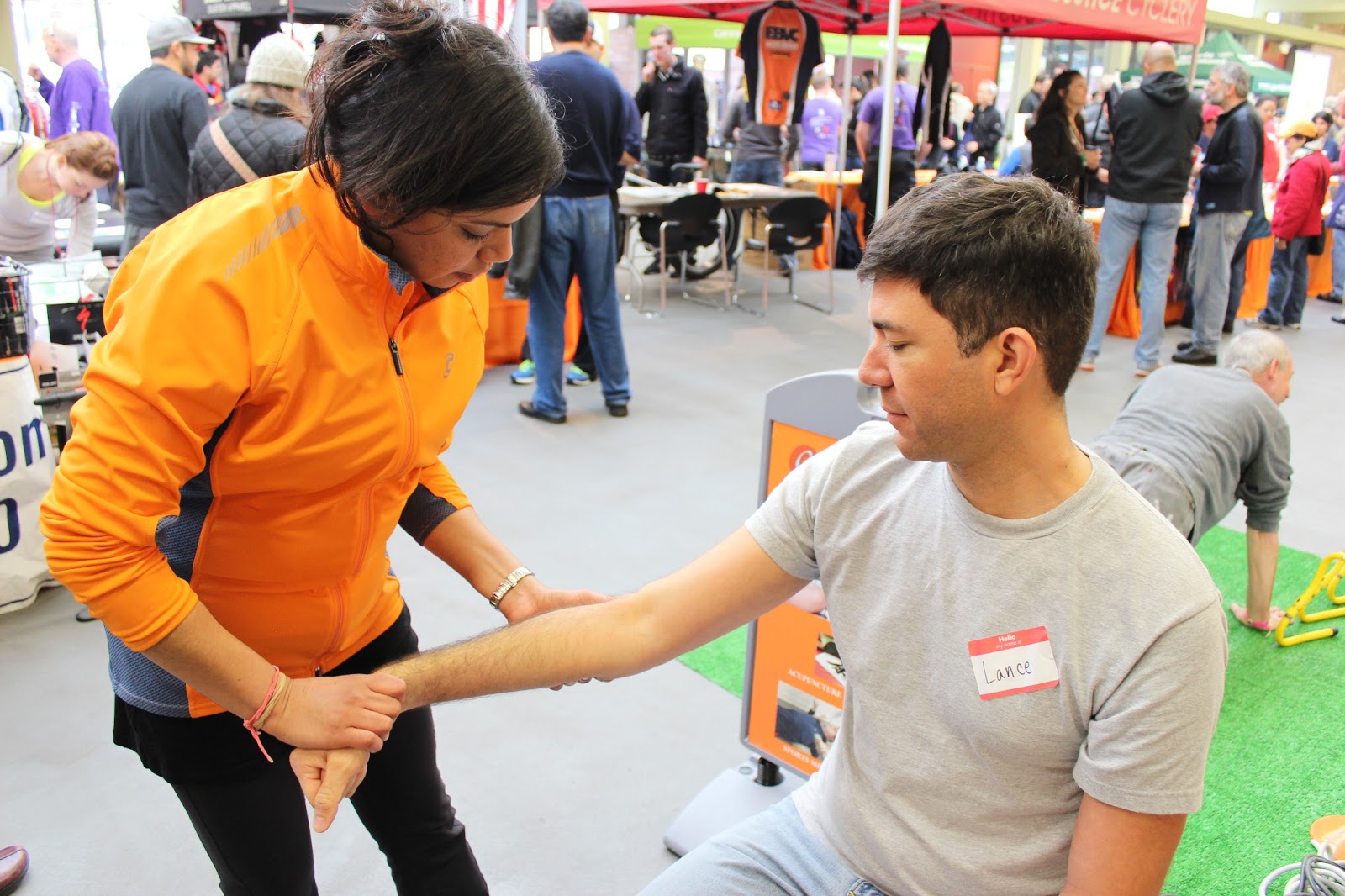
Below are a few pictures of Chiro-Health performing ART on cyclists at the AIDS Life Cycle event in San Francisco. 

                                            Dr.Romo performing ART on a cyclist's hamstring.


                                         Dr.Mazgaloff working on a neck and shoulder.


                                     Dr.Dakoji analyzing a forearm before performing a treatment.


References:
http://www.huffingtonpost.com/2011/08/26/what-active-release-therapy-can-do-for-injured-runners_n_938448.html?utm_hp_ref=fb&src=sp&comm_ref=false
http://online.wsj.com/article/SB10001424127887324640104578165372104222126.html
http://sportsillustrated.cnn.com/vault/article/magazine/MAG1206327/index.htm
http://www.activerelease.com/what_patients.asp

Tuesday, March 5, 2013

What is Acupuncture & Why Should We Care?

When I began my training in acupuncture I had never received an acupuncture treatment, taken herbs, been cupped, or had moxibustion performed on me. I really didn't know anything about Chinese medicine. All I knew was that I had to go study it. I did not have a choice.

At that point in my life I was working on my B.S. in Biology in the Midwest. Due to several factors it became clear that it was time for me to start studying Chinese medicine. I applied to Five Branches University in Santa Cruz, withdrew from the university I was attending, and called my mother to tell her she was coming out to Missouri in a few weeks to help me move back to California.

Everything worked out and my life and the lives of many people are much better thanks to Chinese medicine. I love continuing to share it people whether it's through patients, family, friends, or educational talks to high school students.

This post will educate you on the basics of Chinese medicine, its history, and its current and potential future role in healthcare. References include the World Health Organization, Blue Poppy Press, and Marilyn Allen.

To begin we'll look at some of the basics of acupuncture, its role in healthcare today, and the regulation of it as a healthcare profession:
  • In California acupuncturists are primary care providers (PCPs).
  • There is a growing demand for acupuncture and insurance coverage from patients. If your plan doesn't cover acupuncture let your insurance provider know you want it! Your insurance provider works for you and you should be empowered when it comes to your access to healthcare.
  • More hospitals in the United States are integrating acupuncture as part of their patient care. In China and other countries acupuncture and herbal medicine are fully integrated in the healthcare system. Western and Chinese medicine used together is shown to provide the best results for patients.
  • In the United States ICD-9 codes are used to diagnose health conditions. The rest of the developed world uses ICD-10 codes. We are behind in many areas of healthcare in this country. In the near future everyone will be moving to a new set of codes, ICD-11. With ICD-11, for the first time, codes for traditional medicine will be included (IC-TM). Because Chinese medicine is the fastest growing and most in demand traditional system of healthcare in the world, the first set of IC-TM codes are based on Chinese medical diagnoses. This means acupuncturists will be able to code for conditions such as Liver Qi Stagnation and Heart Blood Vacuity.
  • Acupuncture is safe, clean, and effective. Licensed acupuncturists receive over 3300 hours of graduate level education in Chinese medicine, Western medicine, and clinical training. They are skilled in evaluating patients from many angles and systems and integrating their knowledge to provide the best, most effective care for each patient.
There is an already large, growing body of research on acupuncture and its efficacy in treating many conditions. The World Health Organization (WHO) recognizes acupuncture's effectiveness for over forty common disorders, such as:
  • Ear, Nose & Throat Disorders - toothaches, earaches, sinusitis, rhinitis, laryngitis
  • Respiratory Disorders - colds and flu, bronchitis, asthma, allergies, emphysema
  • Gastrointestinal Disorders - food allergies, nausea, indigestion, diarrhea, constipation, ulcers, colitis
  • Circulatory Disorders - hypertension, high cholesterol, arteriosclerosis, angina pectoris
  • Urogenital Disorders - cystitis, stress incontinence, neurogenic bladder, prostatitis,
  • Gynecological Disorders - menstrual irregularity, endometriosis, PMS, infertility, menopause
  • Musculoskeletal Disorders - Tennis elbow, frozen shoulder, TMJ sciatica, low back pain, arthritis, carpal tunnel syndrome, fibromyalgia
  • Psycho-emotional & Neurological Disorders - depression, anxiety, insomnia, headache, migraine, trigeminal neuralgia, intercostal neuralgia, post-stroke paralysis, dizziness, tinnitus.
Next let's look at some of the basics of Chinese medicine:
  • The "branches" of Chinese medicine are acupuncture, herbal medicine, dietetics, bodywork, and health exercises (Qi Gong or Chi Kung).
  • Acupuncture involves the insertion of very fine, solid needles into the body at specific points shown to be effective in the treatment of specific health problems. These points have been mapped by the Chinese over thousands of years. In the past few decades, electromagnetic research has confirmed the existence and location of these points.
  • Herbal medicine uses a variety of plants, animals, and minerals in the treatment of illness. Chinese herbal medicine is extremely refined in its administering of medicine. It combines many different substances (anywhere from two to twenty ingredients) into formulas to customize the medicine specifically to each patient and their condition.
  • Bodywork includes adjustments, realigning bones and muscles, as well as cupping, gua sha, and moxibustion. Cupping involves the suctioning of glass cups to the body via heat to release the muscles, draw out toxins, and stimulate the body's self-healing properties. Moxibustion is a form of heat therapy that involves burning an herb, mugwort, in different forms, either on needles, or directly on the skin.
  • Chinese medicine is a holistic health approach that looks at patterns on all levels of a patient's experience (physical, mental, emotional) and gives the patient tools to participate in their healing. Chinese medicine aims to empower the patient in their health and lives and give them tools for personal transformation.
Following are some common questions asked about acupuncture:
How does acupuncture work?
  • In spite of the research showing the efficacy of acupuncture in treating many conditions, the actual mechanisms through which it works is unknown in terms of Western medicine. Some people think neurotransmitters, hormones, nerves, or other chemicals in our body are involved.
  • Traditional thought on mechanisms of action involve the flow of Qi (an esoteric way of describing the function of the systems of the body) through channels that cover the body much like nerves and blood vessels. Acupuncture adjusts the flow of Qi in the body, bringing it to areas where there isn't enough, and moving it out of areas where it is stuck.
  • Basically, acupuncture brings the body into balance and sends messages to the body to tell it to heal itself.
Does it hurt?
  • Acupuncture needles are typically not much thicker than a hair. In fact, you can fit three hundred acupuncture needles in the hole of a needle used to give injections and vaccines.
  • In some cases you will not even know the needles are in place. Other times there may be some tingling, warmth, or heaviness.
  • Most people find acupuncture extremely relaxing and many fall asleep during treatment.
  • In the treatment of some conditions trigger points will be used which can feel similar to receiving a deep tissue massage when needled.
  • There are different styles of acupuncture and all feel a little different when performed.
When will it work?
  • Patients often experience results in the first treatment. Some atients experience an immediate total or partial relief of their pain or other symptoms. This relief may last or some pain may return. In a few cases, there may be no immediate relief only to notice the pain diminish over the next couple of days. Generally, you should expect to feel better.
  • Treatment will happen over a period of time to fully correct an issue.
Acupuncture is a safe, effective system of medicine that continues to grow in popularity throughout the world. If you have any questions about Chinese medicine ask a licensed practitioner and receive a treatment. Continue to empower yourself in your life and your healthcare.

~Joshuah Ciafardone, L.Ac

WHO study on acupuncture

Tuesday, February 19, 2013

The Heart in Chinese Medicine

February is a beautiful month. We are still in Winter but the light has begun to return and we are moving towards Spring. The seeds that were planted last year are beginning to take root and in the same way, symbolically, our intentions for the New Year are beginning to grow and take form. February is the also the month in which we celebrate Valentine's Day. With today being Valentine's Day I decided it would be fun to introduce the Heart as it is viewed in Chinese medicine. In Chinese medicine all the organs in our body have associated channels and meridians. They connect everything and integrate us as whole beings. One way to think of it is like highways connecting different cities together. Everything in Chinese medicine is about connections, relationships, and patterns. In this scheme of things everything is described metaphorically or symbolically to help us understand different aspects of ourselves and how we relate to ourselves and the world around us.

One way of describing the channels and organs in our bodies is by designating them as government officials. The Heart, then, is the Emperor, or Supreme Controller. The job of the Emperor is to keep things ordered, to keep everything organized, in control, and most importantly to delegate what needs to be done to the appropriate people and places. They must find the balance between creating solid boundaries and rules without being overbearing and also allowing for creative freedom. The Emperor must know that he or she cannot do everything on their own and that by knowing what they can do and what someone else can do better there will be health, vitality, and harmony. They must be humble while at the same time recognizing their position and source of power. The Emperor stays in the palace - a safe and sacred space. The essential parts of the Self need to be kept safe and so other officials bring and take information from the Emperor to the rest of the kingdom.

If all that talk about emperors and kingdoms doesn't sit well with your Democratic mind we can look at the Heart from another perspective - the Chinese five elements, or phases/cycles of nature. The Heart is associated with Fire, along with the Small Intestine, Pericardium, and Triple Heater. Fire is about love and relationship. It is about the ways in which we make connections and order our perceptions of reality. The emotion associated with it is joy and its sound is laughter. Fire is about an innate love for being alive. It is like being in a meadow full of wildflowers on a sunny summer day with your arms thrown open, your head thrown back to the sky, and immense joy bubbling out of you as laughter. It is like pressing your head to a loved ones' chest and hearing the beat of their heart. It is the satisfaction of leading a project and seeing it succeed with all the pieces moving together as an integrated whole.

The above are all healthy manifestations of Fire. On the flip side our fire can become imbalanced, either excessively or deficiently. Someone who has lost their love for life and finds no joy in anything or is unable to accept love and affection is someone who is lacking Fire. Those with excessive Fire may be scatterbrained, over-controlling, unable to focus, feverish, overworked, inappropriate, experience palpitations or insomnia, or unable to be comfortable in solitude.

More specifically in regards to the Heart, it's aspect of Fire is the one associated with delegation, with finding joy in seeing one's life working out well. It is about living authentically as oneself and being able to navigate different social situations and relationships with different personalities. The Heart is also the spiritual source of Fire, meaning it finds something more in mundane things. It is the one who sees a Universal connection in a beautiful sunset. The Heart is the essential part of who we are and the authentic expression of who we are in the world around us. The Heart is like the Sun. It is the Fire that burns with no external support. It doesn't need oxygen or wood. It is completely self-sufficient unto itself.

Take notice of the qualities of the Heart and the Fire element over the next few weeks. See where they show up in your life. Where it's easy to connect with them and where you don't feel much resonance. Where are you being authentic in your life? Where can you be more authentic? When could your Heart be more open? When is too open and needs to be protected? Notice how as the season is changing more light and warmth is coming back to the days and how that ignites more fire within us. Next week look for a practical application of the Heart. We'll either look at a case study, research, or application of acupuncture points in treating conditions related to the Heart.

~Joshuah Ciafardone, L.Ac

Tuesday, January 15, 2013

Easy and Practical Ways to Improve Your Posture

Correct posture is a simple but very important way to keep the many intricate structures in the back and spine healthy. It is much more than cosmetic-good posture and back support are critical to reducing the incidence and levels of back pain and neck pain. Back support is especially important for patients who spend many hours sitting in an office chair or standing throughout the day. 

Not maintaining good posture and adequate back support can add strain to muscles and put stress on the spine. Over time, the stress of poor posture can change the anatomical characteristics of the spine, leading to the possibility of constricted blood vessels and nerves, as well as problems with muscles, discs and joints. All of these can be major contributors to back and neck pain, as well as headaches, fatigue, and possibly even concerns with major organs and breathing.


As a gift this month we are offering free postural evaluations to friends, family and co-workers of our patients. So if you know of anyone that could benefit from our care, have them call us and set an appointment. Below are also simple ways for you to work on your posture and work and at home. 


All you need are two tennis balls. Whether you are at work or your home computer try this easy trick. The idea is to sit up straight and keep the tennis balls pinned against the chair with your shoulder blades.If the balls start to slide down then you know that your posture is incorrect. 


  For this next tip all you need some type of tape that will stay on your skin. This could be special kinesio-tape or first aid tape. Start by retracting you shoulder blades then tape from the middle of one shoulder blade to the other. If you let your shoulders roll forward or begin to slouch you will feel the tape tighten up and pull on you. 


Monday, June 20, 2011

P90X Exercise Program - is it for you?

It seems that every year, as the weather gets warmer and the days grow longer, we get inspired to exercise more.  More frequently, more intensely.  We create goals for ourselves: I want to lose 10 pounds; I want to walk to work; I want to run a marathon.  Whatever your goal and whatever your reason, you need to find a program that works for you.

After many years of trial and a lot of error, I have found what works best for me: I need to exercise at home, by myself, on my own schedule, every day.  I am not someone who benefits from a workout buddy, nor am I someone who can exercise several days per week.  I am a self-motivated, all-or-nothing person.  To this end, I find the P90X program is perfect for me.

For those unfamiliar with P90X, it is a series of 12 DVDS, each about 1 - 1 1/2 hrs in length that promises a full-body workout including training for strength, balance and cardiovascular fitness.  There are several reasons I like this program:
1. I can do it whenever I have the time; I do not have to worry about being late for a class
2. It works my entire body
3. I can decide how hard I want to work; how sore I want to be (or not)
4. It is designed to safely train you on a daily basis
5. It is inheirently easy to increase the challenge level as your fitness improves
6. It requires almost no equipment (my current "weights" are two cans of garbanzo beans)

That being said, there are several drawbacks that should be mentioned to anyone considering the program:
1. Each workout is at least 1 hour long, which can be difficult to work into your schedule
2. It works best when you do it daily, which can be hard for some people or even lead to injury
3. It is very challenging; someone without proper knowledge of biomechanics may injury themselves

The program has several variations; I do not want to be a body-builder, I just want to be healthy.  For that reason, I stick with the "lean" program; it has a good dose of strength training while focusing on cardiovascular fitness. 

Is P90X for you?  Consider the pros and cons seriously before deciding.  Either way, you need to be careful injury during any exercise.  The best way to do this is to make sure your joints and muscles are properly aligned, that you warm up and cool down, stay well-hydrated and always work within your limits.  My favorite solution to any aches and pains is to use my foam roller and get a chiropractic adjustment.  Fixes me up every time!

Friday, June 3, 2011

Gluten-Free Feasting

Recently, Dr. Medel had house guests who were both gluten-sensitive and vegetarian. The issue of gluten sensitivity is one that is rising in the public's attention. As wheat farmers use more and more genetically modified grain and fewer and fewer species of wheat, many people are beginning to show signs of sensitivity to wheat and wheat gluten.

While living gluten-free can be daunting at first (it seems like it's everywhere!) Dr. Medel was able to come up with a bunch of crowd-pleasing recipes that satisfied her guests dietary restrictions. Below are some of her favorites:

Goat cheese marinated in pesto/roasted red pepper
Make pesto sauce or roasted red pepper sauce making sure the oil content is on the high side. Spoon some of each into separate freezer bags. Set the bags into a shallow dish (I used a brownie pan). Place a hunk of goat cheese into each bag. Spoon more of the sauce over the top of the cheese. Close the bags, making sure all the air is out and the cheese is completely covered in the sauce. Place in the refrigerator for at least 6 hours prior to serving. Serve with gluten free crackers (Glutino brand, Sesamark brand).

Roasted red pepper hummus
In a blender, combine one can of garbanzo beans, 1 ½ teaspoons tahini, 1 tsp minced garlic, ¾ cup roast red peppers, cayenne pepper and salt to taste. I like to use the jars of minced garlic and the red peppers, but you can certainly make your own. I made my own tahini by grinding sesame seeds in a Magic bullet until they had a pasty consistency.

Spinach potato nutmeg soup - One of my favorite soups!
In a frying pan, brown one half a white onion, diced, with a small amount of canola oil. Add salt and pepper to taste. In a large stock pot, combine the onions with a vegetable broth. Bring vegetable broth to a boil. Add spoon-sized pieces of potato and several teaspoons of nutmeg. When the potatoes are done, keep the heat on medium and add several cups of fresh spinach. Heat the spinach through and serve immediately. (This soup accepts meatballs or pork sausage nicely, if you have meat-eaters at your table. Just cook the meat separately and add it when you add the spinach)

Green salad with broccoli stems and Italian dressing
In a large salad bowl, combine: chopped green leaf lettuce, chopped vine ripened tomatoes, chopped carrots, broccoli stems chopped into ¼” quarters, alfalfa sprouts. Serve with artichoke hearts in oil or an Italian dressing.

Green salad with beet greens and peaches
Recycle the left-overs of the salad above and add chopped beet greens and chopped yellow peaches. (I find that as long as you keep the oily ingredients like artichokes or cheese out of the main salad bowl, you can add new ingredients the next day to have a whole new taste without the greens wilting)

Spicy peach dressing
In a small bowl, whisk together ¾ cup canola oil, ½ cup apple cider vinegar, 1 minced yellow peach, ½-1 tsp red pepper flakes, 1 tsp sugar, ½ tsp black pepper, ½ tsp minced garlic. Serve with a small ladle so that you can grab the peach bits at the bottom.

Apple-a-day salad with candied walnuts and spicy balsamic vinaigrette
This is an adaptation of a salad from a favorite lunch spot in SF.

In a medium saucepan, place about 1 ½ cups white sugar. Melt over medium-high heat, stirring constantly. Do not let the sugar burn! When the sugar has turned to liquid and reached a medium amber color, pour in about 2-3 cups of walnuts. Turn off the heat. Stir to coat the nuts in the sugar. You need to work fast, as the nuts will begin to stick together and to the spoon. Once coated, pour them out onto a parchment paper sheet or greased cookie sheet. Separate the nuts from each other to prevent them forming chunks. (I like to put on dish gloves and then butter the fingertips. This allows me to separate the nuts without getting stuck or sticky and prevents me from burning my fingers too badly)

Once the nuts are cooling, chop green leaf lettuce into a bowl. Add 2-3 chopped granny smith apples, 1 cup of dried cranberries and one cup of crumbled blue cheese. Add the nuts once they are cool and serve with a spicy, acidic dressing like Ken’s Steakhouse Balsamic Vinaigrette.

Quinoa with roasted veggies: beets, Brussels sprouts, onions, sweet potato

Prepare the quinoa as directed on the package. The idea here is to serve the quinoa and allow people to dress it with the various vegetables as they like.

Beets: Wash them well! They can taste like dirt if you are not careful. Chop beats into spoon-sized quarters. Place in a baking dish and pour olive oil, kosher salt and black pepper over the tops. Use a spoon to mix them all together, coating the beats. Re-season if desired. Cover and bake at 350 for about 1 hour.

Brussels sprouts: Cut each sprout in half, lengthwise. Place them in a baking dish with their cores facing up. Melt butter and drizzle it over the tops, adding salt and pepper to taste. Bake covered fro 30 min.

Onions: Chop half a while onion and half a red onion into spoon-sized pieces. Use your fingers to separate the layers if needed. Place the onions in a bowl. In a small saucepan on the stove, heat ½ cup honey and ½ cup balsamic vinegar and stir until combined. Pour over the onions. Stir and let sit for 20 minutes. Pour the onions onto a cookie sheet and bake at 350 for 20-30 minutes, stirring once half way through. (These onions should be sweet and soft, but still have a little bit of texture when you bite into them)

Sweet potato: Wash your potatoes well. Chop them lengthwise into about 4 large pieces. Place the pieces in a baking dish with the flesh of the potatoes facing up. You can cram them in; don’t worry about leaving space in between. Bake covered at 350 for one hour or until they are fork-tender. Remove from the oven and allow to cool slightly. Using a small knife, cut into the side of the peel of each piece of potato, and remove the peel. Then chop the cooked potato into spoon-sized pieces. These are great on their own, but are also nice served with butter, nutmeg, cinnamon, maple syrup or brown sugar.

Chocolate chip banana bread
Follow any recipe you like, substituting all purpose wheat flour with all purpose gluten-free flour.  Add about 1 ½ tsp xanthum gum and keep the other rising ingredients at the same proportions.  My favorite is the recipe found in the Joy of Cooking for Banana Quick Bread.  I always add extra banana, and use about a cup of chocolate chips.  The result is moist and cakey.  Yum!

Peach plum pound cake with blackberry honey glaze and whipped cream
Replace wheat flour with gluten-free baking flour and add about 1 ½ tsp of xanthum gum.  I used a basic pound cake recipe, adding in cubed fresh peaches and cubed dried plums.  For the glaze, I melted honey on the stovetop, adding a bit of light corn syrup to give it a more liquid consistency, and then added fresh blackberries.  I cooked the blackberries for about 5-7 minutes; just enough to soften them without actually breaking them down.  I presented the cake and then poured the glaze over the top.  It was beautiful!  Everyone got a dollop of whipped cream on top (1 pint heavy whipping cream and 2 table spoons of sugar plus 1 tsp. vanilla extract).  Next time, I think I would also cook the peaches a bit before putting them in the cake.  Putting them on the stovetop on a frying pan with a little sugar to make them glaze up would have helped bring out the flavor.