Wednesday, May 15, 2013

Shoe or No Shoe?


    Whether you're an avid runner or not, it is likely that you have seen someone wearing Vibram toe shoes. One of if not the biggest debate within running communities is whether it is better to run with a classic running shoe or one with barefoot. Legitimate arguments exist for both sides of the debate.
    Barefoot running advocates point out that humans ran and walked without shoes for millions of years, arguing that going barefoot is natural for humans and can reverse injuries caused by modern running techniques while preventing future problems. But those against barefoot running like to remind us that asphalt and concrete didn't always exist and that there were very few 50 or 60 year old running millions of years ago.
    A study led by Harvard professor Daniel Lieberman suggest that runners who don't wear shoes have a significantly different foot strike that minimizes structural impact compared to those who wear shoes. Barefoot runners tend to point their toes when landing, putting the impact at the middle or front of the foot instead of on the heel making the runner less prone to repetitive stress injuries. This foot strike pattern was also shown to be more economical because runners use less energy to run the same distance as runners using traditional shoes and striking on the heel.
    On the other hand a trial published in the journal Medicine &Science in Sports & Exercise raises question whether barefoot running actually develops a different set of running injuries. Runners were given pre and post MRI studies of their feet. The MRI images showed that over half of them had developed increased bone-marrow edema in the tarsals and metatarsal bones.
    One helpful point to take from this is that not everyone who makes the switch to barefoot technology will end up with injuries. However anyone planning on doing so needs to be extremely cautious during the transition period. It is important to allow foot and calf muscles to adapt. Whether you plan on running with barefoot minimalist shoes or completely barefoot using a mid range cushioned shoe initially can be a good transition. When it comes to injury prevention and running efficiency, it's much more important how you run than what you run in. Heel strikers will sustain more impact injuries than those who allow their arches to act as natural shock absorbers. The most efficient and least injury-prone runners shorten their stride, land on the forefoot and keep the running motion smooth, light and flowing.
    At Chiro-Health we have years of experience working with runners of all skill levels. Whether you have more question on barefoot running, or want a gait analysis to determine which type of running shoe is ideal for we are here to help. You can reach us by phone at (415) 546-1461 or shoot us an e-mail at frontdesk@chirohealthsf.com .
 
References: http://www.dynamicchiropractic.com/mpacms/dc/article.php?id=56486

Tuesday, April 16, 2013

Stress: How to Not Let It Affect You


Our lives are full of stressful situations. Whether you were trying to beat that April 15th tax deadline or didn't and now have to request an extension, chances are you were stressed out. Stress is recognized as the #1 proxy killer disease today. The American Medical Association has noted that stress is the basic cause of more than 60% of all human illness and disease. Below is a diagram showing you how stress can affect your body and some insightful stress facts that many people are unaware of. Don't let stress take over your life and ask us how we can help you out with Chiropractic care. 


                          ( http://www.heartmath.com/infographics/how-stress-effects-the-body.html)

Fact #1 Your body doesn't care if it's a big stress or a little one. Regardless of the significance, stress affects the body in predictable ways.If these reactions are left unchecked we age prematurely, our cognitive function is impaired, our energy is drained and we are robbed of our effectiveness and clarity.

Fact #2 Stress can make people do stupid things. Stress causes what brain researchers call "cortical inhibition". This means that stress inhibits a part of your brain and you can't function at your best. 

Fact #3 People can become numb to their stress. Physiologically we may be under stress, but mentally numb to it because we've grown accustomed to it. Although they may be small these stresses can accumulate and we may not realize how much they're impairing our mental and emotional clarity and overall health. This may show up as a bad decision, overreaction or an unwanted diagnosis at the doctor's office. 

Fact #4 We can control how we respond to stress. 

Fact#5 The best strategy is to control stress in the moment. Don't hold stress all the day and wait until after work to go to yoga or the gym to relief stress. By this time our bodies have already initiated the stress response and it is our overall health that suffers. 


Thursday, April 11, 2013

Movements of Nature in Chinese Medicine - Spring Time Part I

"I sit with my back against an old oak tree,
The wind blows, grass lifts around me,
The tree remains steady,
The wind pushes me forward,
My eyes tear with the rising impulse,

Spring bursts forth,
It is full of life,
Vision clear,
See the plan,
 
What do you see,
What do you judge,
What is the plan,
Shout to the world,"


In Chinese thought there are many ways of describing the world around us and our experience of it. One of them is the model of the Five Elements, or Five Phases. I prefer the term Five Phases because it denotes movements of energy over periods of time as opposed to static building blocks of reality. The Chinese phases are Wood, Fire, Earth, Metal, and Water. In a previous post I described some of the qualities of Fire as it relates to the Heart organ-meridian system. In this post we will explore the season of Spring which is associated with Wood.

Wood Correspondences (in Chinese Five Phase Theory)
Emotion
Anger
Yin Organ
Liver
Yang Organ
Gallbladder
Sense Organ
Eyes
Body Part
Tendons
Body Fluid
Tears
Sense
Sight
Taste
Sour
Life
Birth
Season
Spring
Color
Blue-green
Virtue
Judgment/Discernment
Direction
East
Climate
Windy
Movement
Upwards, Outwards

Spring is a time of birth and renewal. It is the seed growing upwards and breaking ground. There is an energy of bursting forth and moving upwards. The Yang Qi becomes dominant, bursting out of Yin which has been dominant in Autumn and Winter. The light begins to return, the days become longer, and the temperature begins to warm. The state of expansive potential associated with Winter shifts into the state of manifested potential. The full realization of potential won't happen until the Summer. There is still a quality of the unknown present in Spring.

Spring can be a difficult time for people because of all the change and movement happening. After the deep contemplation of Winter it can be a jarring shift to move into Spring. The movement happening in nature can stir up Wind - both metaphorically and literally. Things might seem like they're a little out of control and overwhelming. People will experience allergies, frustration, and a sense of being disoriented. All these things are normal and by knowing what's happening in nature we can learn to adjust to the changing seasons more easily, helping any physical symptoms to become less severe. 

The Liver likes things to be consistent and organized. The Liver is associated with vision on all levels (i.e. physical, having foresight for future projects, opportunities, etc.). Because Spring is a time of change the Liver can become irritated. It may be unable to see what will happen in the future because the potential of Winter is still being shaped into what it will become. It is analogous to the feeling that occurs whiel driving behind a large truck and being unable to see the road ahead of you. 

Spring invites us to learn to move with the currents of nature, to be okay with the unknown as it is happening. Winter is more a time of deep contemplation where we learn to sit with mystery and the unknown in a state of darkness, quiet, and stillness. Spring is a time of driving 90 mph on a winding road that we are unfamiliar with. In the Winter we use the time to discern what no longer serves us and Spring is when we get rid of it all (Spring cleaning). This process can leave us feeling raw, vulnerable, and a little rough around the edges.

Finding things in our life that we know will be consistent is helpful during Spring. Having an anchor to hold onto while things are shifting and being let go of helps us feel secure in the process. It makes change and growth more comfortable. 

We want to put ourselves at the eye of the storm where there is stillness as opposed to being on the periphery where the tornado is blowing strong and we might get hit with a flying cow. Focusing on the positive qualities that change and growth will bring into our lives will help us allow it to happen with less resistance. Asking where we want to go, where we see ourselves going, and why we want to get there will help the journey be more enjoyable. Spring and Autumn are all about the journey. Winter and Summer are more related to the destination. They are the rest in the light and dark. Spring and Autumn are navigating the old rickety bridge between two mountains.

Self-Care Tips for Spring
  • Be asleep or in bed resting between 11 am and 3 am. This is the period where the Qi is strongest in the Liver and Gladder. It allows them to carry out their functions of judgment, discernment, vision, and refurbishment. Less sleep starting earlier will always be more beneficial than more sleep starting later.
  • Contemplate or journal about visions, dreams, what you want to let go of, what you want to bring in to your life, and how those changes will help you be more content in life.
  • Dietary support for the liver requires to things: healthy proteins that allow the liver to function properly and sour/bitter foods. A great combination is a green apple, a little lemon juice, cilantro, and dandelion greens. Be careful not to overdo cold, raw, bitter foods because they can negatively impact digestion. If you notice coldness, loose stools, cramping pain, or fatigue, it means you're probably overdoing it.
  • Be smart about detoxes, cleanses, and fasts. The liver requires energy to work properly. Juicing removes all the fiber from the fruit or vegetable which means the body absorbs all the sugar very quickly. This leads to dangerous spiking of blood sugar levels and is taxing on the pancreas. Juice fasting may be helpful in serious situations but should not be self prescribed and done with the guidance of a trained healthcare professional. For most people having a healthy, consistent diet, taking care of yourself, and getting adequate sleep is going to allow your body and life to detoxify most effectively.
  • Create consistency in your life to help the liver in this time of change. Go to bed at the same time. Wake up at the same time. Eat at the same time. Create things your body knows it can rely on. Create a feeling of safety in your life.
  • Be okay with feeling off balance and a little confused during this period. You will get through it and you will be better for it afterward.
This week we explored the energetic movement of Spring in nature and our bodies. We looked at how associations with Spring show up both literally and metaphorically in our lives and bodies. Next week we will look at the biomedical physiology of how the liver detoxifies our bodies as well as talk more about allergies and how Chinese medicine helps with them. Questions are always welcome.

~Joshuah Ciafardone, L.Ac
Wednesday, March 13, 2013

Active Release Technique: Soft Tissue Treatment


          Active release technique, also known as ART, is a combination of movement and massage to treat pain in ligaments, nerves, tendons, muscles, and other connective tissue in the body. For over 20 years Sports Doctors have incorporated ART as a tool when treating athletes and for this reason it is quite popular with athletes, but ART can be beneficial for anyone with soft tissue injuries. ART has been getting mainstream attention and has been featured in media sources such as Huffington Post, The Wall Street Journal and Sports Illustrated. A recent Sports Illustrated article documenting Peyton Manning's return to football after 4 neck surgeries has him explaining how ART has been crucial in his road to recovery. 
          Common soft tissue injuries that have been resolved by ART include back pain, carpal tunnel syndrome, shin splints, shoulder pain, sciatica, plantar fasciitis, knee problems, and tennis elbow. These conditions all have one important thing in common: they are often a result of overused muscles. Overused muscles usually occur in one of three ways: acute condition (pulls, tears, collisions), accumulation of small tears (micro-trauma) and not getting enough oxygen (hypoxia). Each of these factors can cause your body to produce tough, dense scar tissue in the affected area. This scar tissue binds up and ties down tissues that need to move freely. As scar tissue builds up, muscles become shorter and weaker, tension on tendons causes tendonitis, and nerves can become trapped. This can cause reduced range of motion, loss of strength, and pain. If a nerve is trapped you may also feel tingling, numbness, and weakness.
            ART has been described as a combination of a massage and stretch, but it is far from a typical massage. ART is an intense and rigorous form of therapy where the practitioner applies heavy pressure through his thumbs and fingers to scar tissue while moving the surrounding muscles in a full range of motion. The purpose is to break up the scar tissue, thus reducing pain and unlocking joints, muscles or tendons that are restricting your range of motion. 
            In order to perform ART you must be a certified provider, which entails learning over 500 different protocols and getting re-certified every year.If you have any questions or would like to receive ART care feel free to contact us at Chiro-Health. 


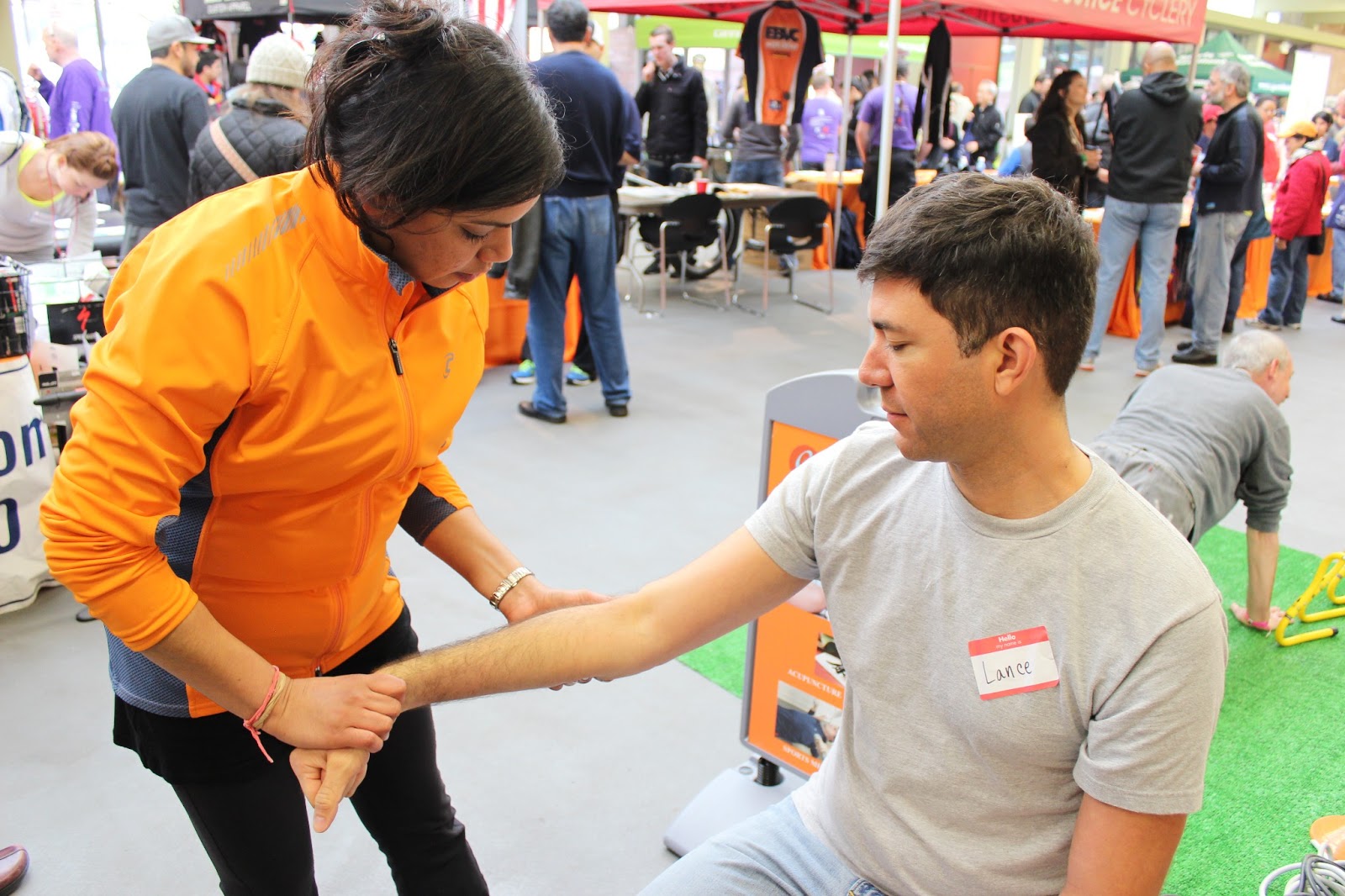
Below are a few pictures of Chiro-Health performing ART on cyclists at the AIDS Life Cycle event in San Francisco. 

                                            Dr.Romo performing ART on a cyclist's hamstring.


                                         Dr.Mazgaloff working on a neck and shoulder.


                                     Dr.Dakoji analyzing a forearm before performing a treatment.


References:
http://www.huffingtonpost.com/2011/08/26/what-active-release-therapy-can-do-for-injured-runners_n_938448.html?utm_hp_ref=fb&src=sp&comm_ref=false
http://online.wsj.com/article/SB10001424127887324640104578165372104222126.html
http://sportsillustrated.cnn.com/vault/article/magazine/MAG1206327/index.htm
http://www.activerelease.com/what_patients.asp

Tuesday, March 5, 2013

What is Acupuncture & Why Should We Care?

When I began my training in acupuncture I had never received an acupuncture treatment, taken herbs, been cupped, or had moxibustion performed on me. I really didn't know anything about Chinese medicine. All I knew was that I had to go study it. I did not have a choice.

At that point in my life I was working on my B.S. in Biology in the Midwest. Due to several factors it became clear that it was time for me to start studying Chinese medicine. I applied to Five Branches University in Santa Cruz, withdrew from the university I was attending, and called my mother to tell her she was coming out to Missouri in a few weeks to help me move back to California.

Everything worked out and my life and the lives of many people are much better thanks to Chinese medicine. I love continuing to share it people whether it's through patients, family, friends, or educational talks to high school students.

This post will educate you on the basics of Chinese medicine, its history, and its current and potential future role in healthcare. References include the World Health Organization, Blue Poppy Press, and Marilyn Allen.

To begin we'll look at some of the basics of acupuncture, its role in healthcare today, and the regulation of it as a healthcare profession:
  • In California acupuncturists are primary care providers (PCPs).
  • There is a growing demand for acupuncture and insurance coverage from patients. If your plan doesn't cover acupuncture let your insurance provider know you want it! Your insurance provider works for you and you should be empowered when it comes to your access to healthcare.
  • More hospitals in the United States are integrating acupuncture as part of their patient care. In China and other countries acupuncture and herbal medicine are fully integrated in the healthcare system. Western and Chinese medicine used together is shown to provide the best results for patients.
  • In the United States ICD-9 codes are used to diagnose health conditions. The rest of the developed world uses ICD-10 codes. We are behind in many areas of healthcare in this country. In the near future everyone will be moving to a new set of codes, ICD-11. With ICD-11, for the first time, codes for traditional medicine will be included (IC-TM). Because Chinese medicine is the fastest growing and most in demand traditional system of healthcare in the world, the first set of IC-TM codes are based on Chinese medical diagnoses. This means acupuncturists will be able to code for conditions such as Liver Qi Stagnation and Heart Blood Vacuity.
  • Acupuncture is safe, clean, and effective. Licensed acupuncturists receive over 3300 hours of graduate level education in Chinese medicine, Western medicine, and clinical training. They are skilled in evaluating patients from many angles and systems and integrating their knowledge to provide the best, most effective care for each patient.
There is an already large, growing body of research on acupuncture and its efficacy in treating many conditions. The World Health Organization (WHO) recognizes acupuncture's effectiveness for over forty common disorders, such as:
  • Ear, Nose & Throat Disorders - toothaches, earaches, sinusitis, rhinitis, laryngitis
  • Respiratory Disorders - colds and flu, bronchitis, asthma, allergies, emphysema
  • Gastrointestinal Disorders - food allergies, nausea, indigestion, diarrhea, constipation, ulcers, colitis
  • Circulatory Disorders - hypertension, high cholesterol, arteriosclerosis, angina pectoris
  • Urogenital Disorders - cystitis, stress incontinence, neurogenic bladder, prostatitis,
  • Gynecological Disorders - menstrual irregularity, endometriosis, PMS, infertility, menopause
  • Musculoskeletal Disorders - Tennis elbow, frozen shoulder, TMJ sciatica, low back pain, arthritis, carpal tunnel syndrome, fibromyalgia
  • Psycho-emotional & Neurological Disorders - depression, anxiety, insomnia, headache, migraine, trigeminal neuralgia, intercostal neuralgia, post-stroke paralysis, dizziness, tinnitus.
Next let's look at some of the basics of Chinese medicine:
  • The "branches" of Chinese medicine are acupuncture, herbal medicine, dietetics, bodywork, and health exercises (Qi Gong or Chi Kung).
  • Acupuncture involves the insertion of very fine, solid needles into the body at specific points shown to be effective in the treatment of specific health problems. These points have been mapped by the Chinese over thousands of years. In the past few decades, electromagnetic research has confirmed the existence and location of these points.
  • Herbal medicine uses a variety of plants, animals, and minerals in the treatment of illness. Chinese herbal medicine is extremely refined in its administering of medicine. It combines many different substances (anywhere from two to twenty ingredients) into formulas to customize the medicine specifically to each patient and their condition.
  • Bodywork includes adjustments, realigning bones and muscles, as well as cupping, gua sha, and moxibustion. Cupping involves the suctioning of glass cups to the body via heat to release the muscles, draw out toxins, and stimulate the body's self-healing properties. Moxibustion is a form of heat therapy that involves burning an herb, mugwort, in different forms, either on needles, or directly on the skin.
  • Chinese medicine is a holistic health approach that looks at patterns on all levels of a patient's experience (physical, mental, emotional) and gives the patient tools to participate in their healing. Chinese medicine aims to empower the patient in their health and lives and give them tools for personal transformation.
Following are some common questions asked about acupuncture:
How does acupuncture work?
  • In spite of the research showing the efficacy of acupuncture in treating many conditions, the actual mechanisms through which it works is unknown in terms of Western medicine. Some people think neurotransmitters, hormones, nerves, or other chemicals in our body are involved.
  • Traditional thought on mechanisms of action involve the flow of Qi (an esoteric way of describing the function of the systems of the body) through channels that cover the body much like nerves and blood vessels. Acupuncture adjusts the flow of Qi in the body, bringing it to areas where there isn't enough, and moving it out of areas where it is stuck.
  • Basically, acupuncture brings the body into balance and sends messages to the body to tell it to heal itself.
Does it hurt?
  • Acupuncture needles are typically not much thicker than a hair. In fact, you can fit three hundred acupuncture needles in the hole of a needle used to give injections and vaccines.
  • In some cases you will not even know the needles are in place. Other times there may be some tingling, warmth, or heaviness.
  • Most people find acupuncture extremely relaxing and many fall asleep during treatment.
  • In the treatment of some conditions trigger points will be used which can feel similar to receiving a deep tissue massage when needled.
  • There are different styles of acupuncture and all feel a little different when performed.
When will it work?
  • Patients often experience results in the first treatment. Some atients experience an immediate total or partial relief of their pain or other symptoms. This relief may last or some pain may return. In a few cases, there may be no immediate relief only to notice the pain diminish over the next couple of days. Generally, you should expect to feel better.
  • Treatment will happen over a period of time to fully correct an issue.
Acupuncture is a safe, effective system of medicine that continues to grow in popularity throughout the world. If you have any questions about Chinese medicine ask a licensed practitioner and receive a treatment. Continue to empower yourself in your life and your healthcare.

~Joshuah Ciafardone, L.Ac

WHO study on acupuncture

Tuesday, February 19, 2013

The Heart in Chinese Medicine

February is a beautiful month. We are still in Winter but the light has begun to return and we are moving towards Spring. The seeds that were planted last year are beginning to take root and in the same way, symbolically, our intentions for the New Year are beginning to grow and take form. February is the also the month in which we celebrate Valentine's Day. With today being Valentine's Day I decided it would be fun to introduce the Heart as it is viewed in Chinese medicine. In Chinese medicine all the organs in our body have associated channels and meridians. They connect everything and integrate us as whole beings. One way to think of it is like highways connecting different cities together. Everything in Chinese medicine is about connections, relationships, and patterns. In this scheme of things everything is described metaphorically or symbolically to help us understand different aspects of ourselves and how we relate to ourselves and the world around us.

One way of describing the channels and organs in our bodies is by designating them as government officials. The Heart, then, is the Emperor, or Supreme Controller. The job of the Emperor is to keep things ordered, to keep everything organized, in control, and most importantly to delegate what needs to be done to the appropriate people and places. They must find the balance between creating solid boundaries and rules without being overbearing and also allowing for creative freedom. The Emperor must know that he or she cannot do everything on their own and that by knowing what they can do and what someone else can do better there will be health, vitality, and harmony. They must be humble while at the same time recognizing their position and source of power. The Emperor stays in the palace - a safe and sacred space. The essential parts of the Self need to be kept safe and so other officials bring and take information from the Emperor to the rest of the kingdom.

If all that talk about emperors and kingdoms doesn't sit well with your Democratic mind we can look at the Heart from another perspective - the Chinese five elements, or phases/cycles of nature. The Heart is associated with Fire, along with the Small Intestine, Pericardium, and Triple Heater. Fire is about love and relationship. It is about the ways in which we make connections and order our perceptions of reality. The emotion associated with it is joy and its sound is laughter. Fire is about an innate love for being alive. It is like being in a meadow full of wildflowers on a sunny summer day with your arms thrown open, your head thrown back to the sky, and immense joy bubbling out of you as laughter. It is like pressing your head to a loved ones' chest and hearing the beat of their heart. It is the satisfaction of leading a project and seeing it succeed with all the pieces moving together as an integrated whole.

The above are all healthy manifestations of Fire. On the flip side our fire can become imbalanced, either excessively or deficiently. Someone who has lost their love for life and finds no joy in anything or is unable to accept love and affection is someone who is lacking Fire. Those with excessive Fire may be scatterbrained, over-controlling, unable to focus, feverish, overworked, inappropriate, experience palpitations or insomnia, or unable to be comfortable in solitude.

More specifically in regards to the Heart, it's aspect of Fire is the one associated with delegation, with finding joy in seeing one's life working out well. It is about living authentically as oneself and being able to navigate different social situations and relationships with different personalities. The Heart is also the spiritual source of Fire, meaning it finds something more in mundane things. It is the one who sees a Universal connection in a beautiful sunset. The Heart is the essential part of who we are and the authentic expression of who we are in the world around us. The Heart is like the Sun. It is the Fire that burns with no external support. It doesn't need oxygen or wood. It is completely self-sufficient unto itself.

Take notice of the qualities of the Heart and the Fire element over the next few weeks. See where they show up in your life. Where it's easy to connect with them and where you don't feel much resonance. Where are you being authentic in your life? Where can you be more authentic? When could your Heart be more open? When is too open and needs to be protected? Notice how as the season is changing more light and warmth is coming back to the days and how that ignites more fire within us. Next week look for a practical application of the Heart. We'll either look at a case study, research, or application of acupuncture points in treating conditions related to the Heart.

~Joshuah Ciafardone, L.Ac

Tuesday, January 15, 2013

Easy and Practical Ways to Improve Your Posture

Correct posture is a simple but very important way to keep the many intricate structures in the back and spine healthy. It is much more than cosmetic-good posture and back support are critical to reducing the incidence and levels of back pain and neck pain. Back support is especially important for patients who spend many hours sitting in an office chair or standing throughout the day. 

Not maintaining good posture and adequate back support can add strain to muscles and put stress on the spine. Over time, the stress of poor posture can change the anatomical characteristics of the spine, leading to the possibility of constricted blood vessels and nerves, as well as problems with muscles, discs and joints. All of these can be major contributors to back and neck pain, as well as headaches, fatigue, and possibly even concerns with major organs and breathing.


As a gift this month we are offering free postural evaluations to friends, family and co-workers of our patients. So if you know of anyone that could benefit from our care, have them call us and set an appointment. Below are also simple ways for you to work on your posture and work and at home. 


All you need are two tennis balls. Whether you are at work or your home computer try this easy trick. The idea is to sit up straight and keep the tennis balls pinned against the chair with your shoulder blades.If the balls start to slide down then you know that your posture is incorrect. 


  For this next tip all you need some type of tape that will stay on your skin. This could be special kinesio-tape or first aid tape. Start by retracting you shoulder blades then tape from the middle of one shoulder blade to the other. If you let your shoulders roll forward or begin to slouch you will feel the tape tighten up and pull on you.