
Wednesday, July 10, 2013


Friday, June 7, 2013
Yoga, The Nervous System, and The Spine

At the request of some of our yoga
students I am writing an entry about the nervous system, how it
relates to the curves of the spine, and how we can affect it through
conscious exercises such as yoga.
Nerves are bands of fibrous tissue that carry messages throughout our bodies. They are much like the wiring in a computer. They are just as real
and palpable as blood vessels,
muscles, and organs. Because nerves are a physical
structure they can be affected by tight muscles, injuries, and
unhealthy posture. Nerve roots are the part of a nerve that exits the spinal cord between two vertebra before it travels out to the rest of the body. They are the place where the two parts of our nervous system communicate.
A
compressed nerve root refers to an actual squeezing
of the nerve as it comes out from between two vertebra on its way to the
rest of the body. If you squeeze a hose that has water running through
it the water flow will be impeded and pressure will build up. The same
thing happens in our nerves where the nerve is the hose and the water is the impulses that carry messages back and forth between the brain
and the body.
Our central nervous system (CNS) is comprised of the brain
and spinal cord. Our peripheral nervous system (PNS) is comprised of
all the nerves that run throughout the rest of our bodies. These two
nervous systems communicate with one another via the nerve roots mentioned previously.
There are two branches within
the peripheral nervous system. They are the Sympathetic branch and
the Parasympathetic branch. Each of the branches holds an opposite
function and our body is constantly adjusting how much each branch is
activated.
The sympathetic branch is responsible for the 'fight or
flight' response. This system is activated in times of stress and
danger and leads to adrenaline being released, heart and breath rates
to quicken, the pupils to dilate, and blood flow to increase. The
parasympathetic branch is responsible for the 'rest and digest'
response. This system is activated in times of low stress. It leads
to blood moving to the organs, the heart and breath rates
to slow down, and an overall sense of relaxation and restfulness.
Problems occur when one of the
branches is overly stimulated for an extended period of time. Because
of our culture, jobs, and life structure, Americans tend towards
having their Sympathetic branch chronically stimulated. This leads to
health issues such as anxiety, chronic stress, weight gain, tight
muscles, headache, low immune system function, difficulty sleeping,
and high blood pressure among others. In order to balance this a
two-part solution must take place. The first is to lower the function
of the Sympathetic branch and the second is to stimulate more
activity of the Parasympathetic branch.
There are many ways we can affect the
branches of the peripheral nervous system. Because the peripheral
nervous system starts in the spine at the junction between the
vertebrae we can affect it by adjusting the spine. Chiropractic care
is an example of how this approach can be employed.
Alternatively we
can send signals from other areas of the body back to the roots of
the nerves to tell the body to calm down. Acupuncture is a good
example of this method. Because there are different approaches it is
important to make use of the different healthcare modalities
available to us and integrate them together to receive the most
effective care.
We can also engage our bodies and
nervous systems on our own without the assistance of someone else.
This is an important approach to take as well because it empowers us
in our bodies and in our lives. It makes receiving other treatments
more effective, longer lasting, and ultimately puts us at a place of
power in our own lives. Yoga is a way of using this approach to
health.
Before we talk about specific yoga
alignment let's take a closer look at the spine. The human spine is
comprised of roughly thirty two bones. There are four curves in the
spine. Two of them are concave and two of them are convex. Bones are
connected to other bones by ligaments and to muscles by tendons.
Between all the layers of muscle there are additional layers of
connective tissue that hold everything together. Misalignments in the
body can be due to bones, muscles, or connective tissue. The spinal
cord runs through the center of the bones of the spine and, along with
the nerve roots, are affected in shape and functionality by the
posture of the spine.
Many systems of yoga and other
exercise use alignment based on old research that showed that
accentuating the natural curves in the spine lead to injuries in the spine
and nerves whereas making the back flat, tucking everything under,
and taking the curves out of the spine lead to greater stability.
There are several problems with these studies. The first is that
since these studies have been accepted and used as the basis for
healthy alignment in our body no one has researched other possible
alternatives. For over sixty years we've accepted that those studies discovered everything we needed to find about proper alignment in the
spine. Secondly, the studies looked at overarching the lower back.
What they didn't look at was the method in which the back was arched.
Simply put, the back can be arched either by collapsing into it and
compressing the vertebrae or by engaging the muscles of the legs to
create a deep but spacious curve in the low back that matches the
spine's natural alignment. Lastly, the studies all looked at arched
backs where the last thoracic vertebrae (T12) in the middle of the
spine poked out. None of the studies looked at alignment where T12
moved in and up, which only happens when the spine is arched through
muscular engagement.
When the curves are taken out of the
spine it causes the nerve roots to become compressed and sends
signals to the brain that the Sympathetic branch needs to be
activated. When the natural curves are put back in the spine it
signals the brain to activate the Parasympathetic nervous system.
Our Sympathetic activation is
exacerbated by the large amount of time that people spend sitting at
desks. Sitting this way leads to several problems. It takes the
natural curve out of the low back, it takes the natural curve out of
the neck and when the chin is lowered it pulls on all the muscles in
the jaw, neck, and upper shoulders, and, finally it tightens our hips
and groins which also stimulates the Sympathetic branch. This also causes the bones of the legs and arms to be pushed forward out of their sockets.
Tucking under requires the engagement of the butt muscles from the top of the butt to the bottom of it. This engages the muscles from the insertion to the origin. We engage every other muscle in our body in the opposite way - from the origin to the insertion. Why would it be that one of the strongest muscles in our body should be the only one that should be engaged opposite from all the other muscles? In the new system of alignment the butt muscles are engaged from the origin to the insertion (bottom to top) which naturally creates a deep spacious curve in the lower back as a result.
If an exercise class is using an old system of alignment it is basically creating the same posture we end up in sitting at desks and in cars. We end up creating the same problems we're trying to fix. The new system of alignment reverses these tendencies and reintroduces the natural curves back into the spine. Some basics of the
new system of alignment I use in my teaching are:
1) Make the legs strong
2) Use this strength to create a
spacious, deep arch in the low back until T12 moves in and up
3) Allow the upper back to soften and
the ribs to move towards the ground
4) Look up and make the curve in the
neck match the lower back
5) Extend the whole body in both
directions from T12
Here is another way of looking at it:
 When an animal is afraid or upset they
round their lower back and neck, and tuck their tail between their
legs. This is the same action of "tucking the tailbone"
under that we have all been instructed to do in the past. This is an
example of what animals do when they are in Sympathetic dominance.
Another example is a cat arching its back when it hisses at
something.
When an animal is afraid or upset they
round their lower back and neck, and tuck their tail between their
legs. This is the same action of "tucking the tailbone"
under that we have all been instructed to do in the past. This is an
example of what animals do when they are in Sympathetic dominance.
Another example is a cat arching its back when it hisses at
something.
When an animal is relaxed and at ease and has just woken up from a nap it takes a nice big stretch as seen here. The lower back is rounded, the groins are soft, the hips are pressing back, and the chin is lifted to create a curve in the neck.
Here are more photo comparisons:


In the first set of photos we can see the difference between the old and new styles of alignment. The bottom picture shows a rounded spine, rounded neck (though usually the rounding is even more severe), and and overall look of unease. The top photo shows strong legs creating a natural arch in the lower back and the chin lifted to create a matching curve in the neck. The shoulders are lifted and the ribside is extended.
The second set of photos shows the new alignment and how it matches with the way animals align their bodies in a stretch. In the top photo I could have even more bend in my knees so as to lengthen the spine and extend the hips back more. Notice how overall the arches of the spine and alignment of the shoulders and hips match up.
The new system of alignment activates
the Parasympathetic nervous system while at the same time
strengthening and toning the body. Because the spine is naturally
curved the nerve roots have the least amount of pressure put on them
when the spine is in its natural alignment. By putting the spine in
this alignment and then using our muscles to lengthen the curves it
creates space between the vertebrae which takes pressure off the
nerve roots, thus sending a message to the brain to activate the
parasympathetic nervous system. Less obstruction and compression on
the nerves creates feelings of ease and restfulness.
When the natural curves of the spine
are supported by clear engagement of the muscles and healthy
alignment of the limbs there is more than enough stability to support
the curves. Old systems of alignment try to take the curves out of
the spine because it is believed that the hyper-mobility of the lower
back and neck are too unstable and easily injured. This assessment is
only true if there is no muscular engagement supporting the arches in
these parts of the spine.
Finally, when we allow the ribcage to descend towards the ground we allow gravity to gently pull on all the connective tissue surrounding our internal organs. When we surrender in this way it further activates the Parasympathetic branch. This isn't to say that the abdominal muscles aren't engaged. They are, but instead of contracting and shortening them we engage them while they stay long and extended.
These are some basics of the way our
nervous system works in conjunction with our anatomy and alignment.
There are many different systems of exercise and alignment available
and it's good to explore many different ones in a safe way so that
you can become more empowered in your own body. Following, I've
included more pictures for comparison.
~Joshuah Ciafardone, L.Ac

The new method of alignment is from the
Sridaiva system of yoga developed by Desi Springer and John Friend.
Wednesday, May 15, 2013
Shoe or No Shoe?
Whether you're an avid runner or not, it is likely that you have seen someone wearing Vibram toe shoes. One of if not the biggest debate within running communities is whether it is better to run with a classic running shoe or one with barefoot. Legitimate arguments exist for both sides of the debate.
Barefoot running advocates point out that humans ran and walked without shoes for millions of years, arguing that going barefoot is natural for humans and can reverse injuries caused by modern running techniques while preventing future problems. But those against barefoot running like to remind us that asphalt and concrete didn't always exist and that there were very few 50 or 60 year old running millions of years ago.
A study led by Harvard professor Daniel Lieberman suggest that runners who don't wear shoes have a significantly different foot strike that minimizes structural impact compared to those who wear shoes. Barefoot runners tend to point their toes when landing, putting the impact at the middle or front of the foot instead of on the heel making the runner less prone to repetitive stress injuries. This foot strike pattern was also shown to be more economical because runners use less energy to run the same distance as runners using traditional shoes and striking on the heel.
On the other hand a trial published in the journal Medicine &Science in Sports & Exercise raises question whether barefoot running actually develops a different set of running injuries. Runners were given pre and post MRI studies of their feet. The MRI images showed that over half of them had developed increased bone-marrow edema in the tarsals and metatarsal bones.
One helpful point to take from this is that not everyone who makes the switch to barefoot technology will end up with injuries. However anyone planning on doing so needs to be extremely cautious during the transition period. It is important to allow foot and calf muscles to adapt. Whether you plan on running with barefoot minimalist shoes or completely barefoot using a mid range cushioned shoe initially can be a good transition. When it comes to injury prevention and running efficiency, it's much more important how you run than what you run in. Heel strikers will sustain more impact injuries than those who allow their arches to act as natural shock absorbers. The most efficient and least injury-prone runners shorten their stride, land on the forefoot and keep the running motion smooth, light and flowing.
At Chiro-Health we have years of experience working with runners of all skill levels. Whether you have more question on barefoot running, or want a gait analysis to determine which type of running shoe is ideal for we are here to help. You can reach us by phone at (415) 546-1461 or shoot us an e-mail at frontdesk@chirohealthsf.com .
References: http://www.dynamicchiropractic.com/mpacms/dc/article.php?id=56486
Tuesday, April 16, 2013
Stress: How to Not Let It Affect You

( http://www.heartmath.com/infographics/how-stress-effects-the-body.html)
Fact #1 Your body doesn't care if it's a big stress or a little one. Regardless of the significance, stress affects the body in predictable ways.If these reactions are left unchecked we age prematurely, our cognitive function is impaired, our energy is drained and we are robbed of our effectiveness and clarity.
Fact #2 Stress can make people do stupid things. Stress causes what brain researchers call "cortical inhibition". This means that stress inhibits a part of your brain and you can't function at your best.
Fact #3 People can become numb to their stress. Physiologically we may be under stress, but mentally numb to it because we've grown accustomed to it. Although they may be small these stresses can accumulate and we may not realize how much they're impairing our mental and emotional clarity and overall health. This may show up as a bad decision, overreaction or an unwanted diagnosis at the doctor's office.
Fact #4 We can control how we respond to stress.
Fact#5 The best strategy is to control stress in the moment. Don't hold stress all the day and wait until after work to go to yoga or the gym to relief stress. By this time our bodies have already initiated the stress response and it is our overall health that suffers.
Thursday, April 11, 2013
Movements of Nature in Chinese Medicine - Spring Time Part I

The wind blows, grass
lifts around me,
The tree remains steady,
The wind pushes me
forward,
My eyes tear with the
rising impulse,
Spring bursts forth,
It is full of life,
Vision clear,
See the plan,
What do you see,
What do you judge,
What is the plan,
Shout to the world,"
In Chinese thought there are many ways
of describing the world around us and our experience of it. One of
them is the model of the Five Elements, or Five Phases. I prefer the
term Five Phases because it denotes movements of energy over periods
of time as opposed to static building blocks of reality. The Chinese
phases are Wood, Fire, Earth, Metal, and Water. In a previous post I
described some of the qualities of Fire as it relates to the Heart
organ-meridian system. In this post we will explore the season of
Spring which is associated with Wood.
Wood Correspondences (in
Chinese Five Phase Theory)
|
Emotion
|
Anger
|
|
Yin Organ
|
Liver
|
|
Yang Organ
|
Gallbladder
|
|
Sense Organ
|
Eyes
|
|
Body Part
|
Tendons
|
|
Body Fluid
|
Tears
|
|
Sense
|
Sight
|
|
Taste
|
Sour
|
|
Life
|
Birth
|
|
Season
|
Spring
|
|
Color
|
Blue-green
|
|
Virtue
|
Judgment/Discernment
|
|
Direction
|
East
|
|
Climate
|
Windy
|
|
Movement
|
Upwards, Outwards
|
Spring is a time of birth and renewal.
It is the seed growing upwards and breaking ground. There is an
energy of bursting forth and moving upwards. The Yang Qi becomes
dominant, bursting out of Yin which has been dominant in Autumn and
Winter. The light begins to return, the days become longer, and the
temperature begins to warm. The state of expansive potential
associated with Winter shifts into the state of manifested potential.
The full realization of potential won't happen until the Summer.
There is still a quality of the unknown present in Spring.
Spring can be a difficult time for
people because of all the change and movement happening. After the
deep contemplation of Winter it can be a jarring shift to move into
Spring. The movement happening in nature can stir up Wind - both
metaphorically and literally. Things might seem like they're a little
out of control and overwhelming. People will experience allergies,
frustration, and a sense of being disoriented. All these things are
normal and by knowing what's happening in nature we can learn to
adjust to the changing seasons more easily, helping any physical
symptoms to become less severe.
The Liver likes things to be
consistent and organized. The Liver is associated with vision on all
levels (i.e. physical, having foresight for future projects,
opportunities, etc.). Because Spring is a time of change the Liver
can become irritated. It may be unable to see what will happen in the
future because the potential of Winter is still being shaped into
what it will become. It is analogous to the feeling that occurs whiel
driving behind a large truck and being unable to see the road ahead
of you.
Spring invites us to learn to move
with the currents of nature, to be okay with the unknown as it is
happening. Winter is more a time of deep contemplation where we learn
to sit with mystery and the unknown in a state of darkness, quiet,
and stillness. Spring is a time of driving 90 mph on a winding road
that we are unfamiliar with. In the Winter we use the time to discern
what no longer serves us and Spring is when we get rid of it all
(Spring cleaning). This process can leave us feeling raw, vulnerable,
and a little rough around the edges.
Finding things in our life that we
know will be consistent is helpful during Spring. Having an anchor to
hold onto while things are shifting and being let go of helps us feel
secure in the process. It makes change and growth more comfortable.
We want to put ourselves at the eye of
the storm where there is stillness as opposed to being on the
periphery where the tornado is blowing strong and we might get hit
with a flying cow. Focusing on the positive qualities that change and
growth will bring into our lives will help us allow it to happen with
less resistance. Asking where we want to go, where we see ourselves
going, and why we want to get there will help the journey be more
enjoyable. Spring and Autumn are all about the journey. Winter and
Summer are more related to the destination. They are the rest in the
light and dark. Spring and Autumn are navigating the old rickety
bridge between two mountains.
Self-Care Tips for Spring
- Be asleep or in bed resting between 11 am and 3 am. This is the period where the Qi is strongest in the Liver and Gladder. It allows them to carry out their functions of judgment, discernment, vision, and refurbishment. Less sleep starting earlier will always be more beneficial than more sleep starting later.
- Contemplate or journal about visions, dreams, what you want to let go of, what you want to bring in to your life, and how those changes will help you be more content in life.
- Dietary support for the liver requires to things: healthy proteins that allow the liver to function properly and sour/bitter foods. A great combination is a green apple, a little lemon juice, cilantro, and dandelion greens. Be careful not to overdo cold, raw, bitter foods because they can negatively impact digestion. If you notice coldness, loose stools, cramping pain, or fatigue, it means you're probably overdoing it.
- Be smart about detoxes, cleanses, and fasts. The liver requires energy to work properly. Juicing removes all the fiber from the fruit or vegetable which means the body absorbs all the sugar very quickly. This leads to dangerous spiking of blood sugar levels and is taxing on the pancreas. Juice fasting may be helpful in serious situations but should not be self prescribed and done with the guidance of a trained healthcare professional. For most people having a healthy, consistent diet, taking care of yourself, and getting adequate sleep is going to allow your body and life to detoxify most effectively.
- Create consistency in your life to help the liver in this time of change. Go to bed at the same time. Wake up at the same time. Eat at the same time. Create things your body knows it can rely on. Create a feeling of safety in your life.
- Be okay with feeling off balance and a little confused during this period. You will get through it and you will be better for it afterward.
This week we explored the energetic
movement of Spring in nature and our bodies. We looked at how
associations with Spring show up both literally and metaphorically in
our lives and bodies. Next week we will look at the biomedical
physiology of how the liver detoxifies our bodies as well as talk
more about allergies and how Chinese medicine helps with them.
Questions are always welcome.
~Joshuah Ciafardone, L.Ac
Wednesday, March 13, 2013
Active Release Technique: Soft Tissue Treatment
Active release technique, also known as ART, is a combination of movement and massage to treat pain in ligaments, nerves, tendons, muscles, and other connective tissue in the body. For over 20 years Sports Doctors have incorporated ART as a tool when treating athletes and for this reason it is quite popular with athletes, but ART can be beneficial for anyone with soft tissue injuries. ART has been getting mainstream attention and has been featured in media sources such as Huffington Post, The Wall Street Journal and Sports Illustrated. A recent Sports Illustrated article documenting Peyton Manning's return to football after 4 neck surgeries has him explaining how ART has been crucial in his road to recovery.
Common soft tissue injuries that have been resolved by ART include back pain, carpal tunnel syndrome, shin splints, shoulder pain, sciatica, plantar fasciitis, knee problems, and tennis elbow. These conditions all have one important thing in common: they are often a result of overused muscles. Overused muscles usually occur in one of three ways: acute condition (pulls, tears, collisions), accumulation of small tears (micro-trauma) and not getting enough oxygen (hypoxia). Each of these factors can cause your body to produce tough, dense scar tissue in the affected area. This scar tissue binds up and ties down tissues that need to move freely. As scar tissue builds up, muscles become shorter and weaker, tension on tendons causes tendonitis, and nerves can become trapped. This can cause reduced range of motion, loss of strength, and pain. If a nerve is trapped you may also feel tingling, numbness, and weakness.
ART has been described as a combination of a massage and stretch, but it is far from a typical massage. ART is an intense and rigorous form of therapy where the practitioner applies heavy pressure through his thumbs and fingers to scar tissue while moving the surrounding muscles in a full range of motion. The purpose is to break up the scar tissue, thus reducing pain and unlocking joints, muscles or tendons that are restricting your range of motion.
In order to perform ART you must be a certified provider, which entails learning over 500 different protocols and getting re-certified every year.If you have any questions or would like to receive ART care feel free to contact us at Chiro-Health.
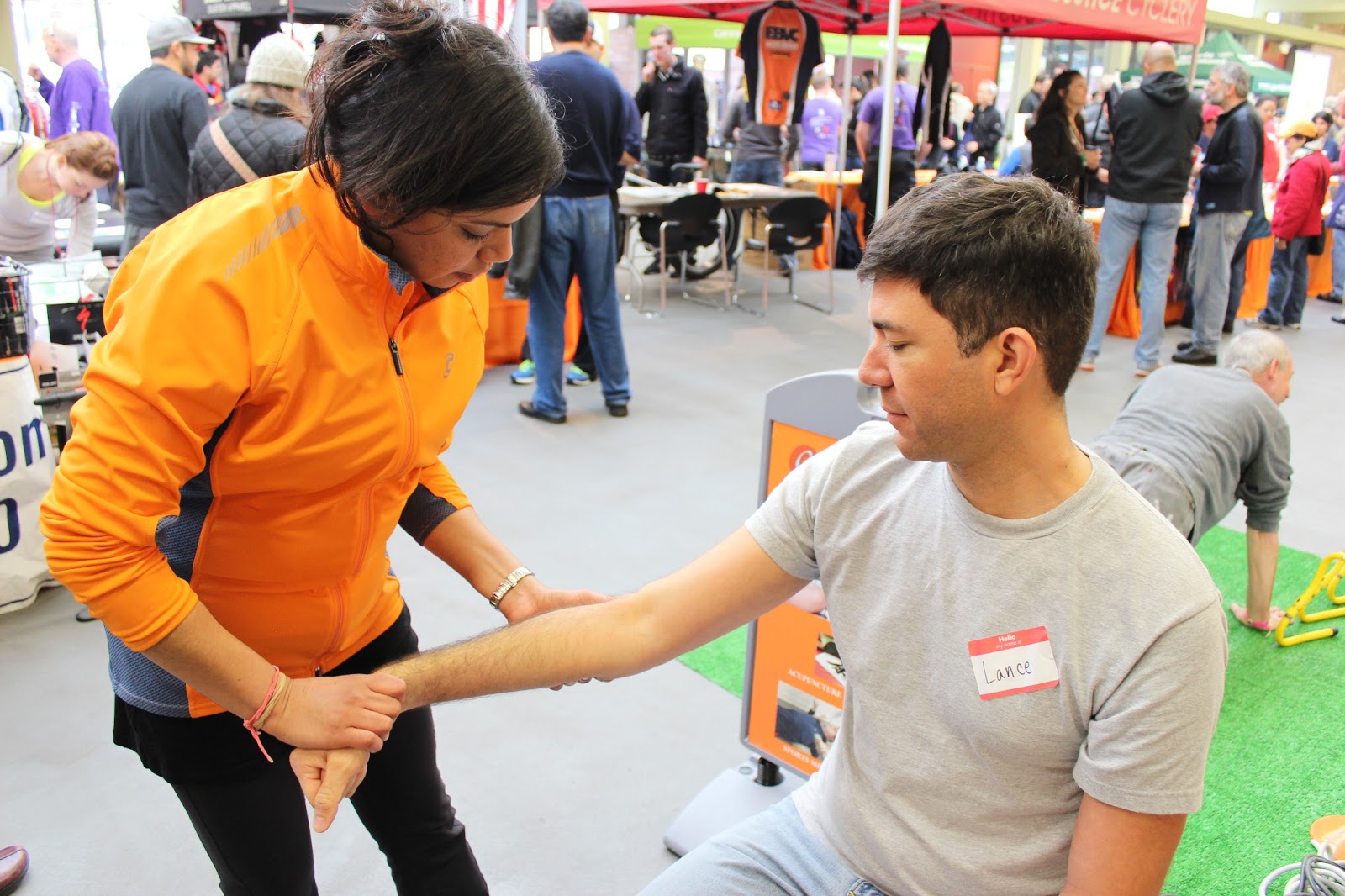
Below are a few pictures of Chiro-Health performing ART on cyclists at the AIDS Life Cycle event in San Francisco.


References:
http://www.huffingtonpost.com/2011/08/26/what-active-release-therapy-can-do-for-injured-runners_n_938448.html?utm_hp_ref=fb&src=sp&comm_ref=false
http://online.wsj.com/article/SB10001424127887324640104578165372104222126.html
http://sportsillustrated.cnn.com/vault/article/magazine/MAG1206327/index.htm
http://www.activerelease.com/what_patients.asp
Tuesday, March 5, 2013
What is Acupuncture & Why Should We Care?

At that point in my life I was working on my B.S. in Biology in the Midwest. Due to several factors it became clear that it was time for me to start studying Chinese medicine. I applied to Five Branches University in Santa Cruz, withdrew from the university I was attending, and called my mother to tell her she was coming out to Missouri in a few weeks to help me move back to California.
Everything worked out and my life and the lives of many people are much better thanks to Chinese medicine. I love continuing to share it people whether it's through patients, family, friends, or educational talks to high school students.
This post will educate you on the basics of Chinese medicine, its history, and its current and potential future role in healthcare. References include the World Health Organization, Blue Poppy Press, and Marilyn Allen.
To begin we'll look at some of the basics of acupuncture, its role in healthcare today, and the regulation of it as a healthcare profession:
- In California acupuncturists are primary care providers (PCPs).
- There is a growing demand for acupuncture and insurance coverage from patients. If your plan doesn't cover acupuncture let your insurance provider know you want it! Your insurance provider works for you and you should be empowered when it comes to your access to healthcare.
- More hospitals in the United States are integrating acupuncture as part of their patient care. In China and other countries acupuncture and herbal medicine are fully integrated in the healthcare system. Western and Chinese medicine used together is shown to provide the best results for patients.
- In the United States ICD-9 codes are used to diagnose health conditions. The rest of the developed world uses ICD-10 codes. We are behind in many areas of healthcare in this country. In the near future everyone will be moving to a new set of codes, ICD-11. With ICD-11, for the first time, codes for traditional medicine will be included (IC-TM). Because Chinese medicine is the fastest growing and most in demand traditional system of healthcare in the world, the first set of IC-TM codes are based on Chinese medical diagnoses. This means acupuncturists will be able to code for conditions such as Liver Qi Stagnation and Heart Blood Vacuity.
- Acupuncture is safe, clean, and effective. Licensed acupuncturists receive over 3300 hours of graduate level education in Chinese medicine, Western medicine, and clinical training. They are skilled in evaluating patients from many angles and systems and integrating their knowledge to provide the best, most effective care for each patient.
- Ear, Nose & Throat Disorders - toothaches, earaches, sinusitis, rhinitis, laryngitis
- Respiratory Disorders - colds and flu, bronchitis, asthma, allergies, emphysema
- Gastrointestinal Disorders - food allergies, nausea, indigestion, diarrhea, constipation, ulcers, colitis
- Circulatory Disorders - hypertension, high cholesterol, arteriosclerosis, angina pectoris
- Urogenital Disorders - cystitis, stress incontinence, neurogenic bladder, prostatitis,
- Gynecological Disorders - menstrual irregularity, endometriosis, PMS, infertility, menopause
- Musculoskeletal Disorders - Tennis elbow, frozen shoulder, TMJ sciatica, low back pain, arthritis, carpal tunnel syndrome, fibromyalgia
- Psycho-emotional & Neurological Disorders - depression, anxiety, insomnia, headache, migraine, trigeminal neuralgia, intercostal neuralgia, post-stroke paralysis, dizziness, tinnitus.
- The "branches" of Chinese medicine are acupuncture, herbal medicine, dietetics, bodywork, and health exercises (Qi Gong or Chi Kung).
- Acupuncture involves the insertion of very fine, solid needles into the body at specific points shown to be effective in the treatment of specific health problems. These points have been mapped by the Chinese over thousands of years. In the past few decades, electromagnetic research has confirmed the existence and location of these points.
- Herbal medicine uses a variety of plants, animals, and minerals in the treatment of illness. Chinese herbal medicine is extremely refined in its administering of medicine. It combines many different substances (anywhere from two to twenty ingredients) into formulas to customize the medicine specifically to each patient and their condition.
- Bodywork includes adjustments, realigning bones and muscles, as well as cupping, gua sha, and moxibustion. Cupping involves the suctioning of glass cups to the body via heat to release the muscles, draw out toxins, and stimulate the body's self-healing properties. Moxibustion is a form of heat therapy that involves burning an herb, mugwort, in different forms, either on needles, or directly on the skin.
- Chinese medicine is a holistic health approach that looks at patterns on all levels of a patient's experience (physical, mental, emotional) and gives the patient tools to participate in their healing. Chinese medicine aims to empower the patient in their health and lives and give them tools for personal transformation.
How does acupuncture work?
- In spite of the research showing the efficacy of acupuncture in treating many conditions, the actual mechanisms through which it works is unknown in terms of Western medicine. Some people think neurotransmitters, hormones, nerves, or other chemicals in our body are involved.
- Traditional thought on mechanisms of action involve the flow of Qi (an esoteric way of describing the function of the systems of the body) through channels that cover the body much like nerves and blood vessels. Acupuncture adjusts the flow of Qi in the body, bringing it to areas where there isn't enough, and moving it out of areas where it is stuck.
- Basically, acupuncture brings the body into balance and sends messages to the body to tell it to heal itself.
- Acupuncture needles are typically not much thicker than a hair. In fact, you can fit three hundred acupuncture needles in the hole of a needle used to give injections and vaccines.
- In some cases you will not even know the needles are in place. Other times there may be some tingling, warmth, or heaviness.
- Most people find acupuncture extremely relaxing and many fall asleep during treatment.
- In the treatment of some conditions trigger points will be used which can feel similar to receiving a deep tissue massage when needled.
- There are different styles of acupuncture and all feel a little different when performed.
- Patients often experience results in the first treatment. Some atients experience an immediate total or partial relief of their pain or other symptoms. This relief may last or some pain may return. In a few cases, there may be no immediate relief only to notice the pain diminish over the next couple of days. Generally, you should expect to feel better.
- Treatment will happen over a period of time to fully correct an issue.
~Joshuah Ciafardone, L.Ac
WHO study on acupuncture
Subscribe to:
Posts (Atom)
